
Your business is listed on Google, Yelp, and a dozen other directories. But if your name, address, or phone number is different on even a few of them, Google has a problem.
It cannot tell which version of your business is correct. So it trusts none of them fully. And when Google cannot fully trust your business data, your local rankings suffer.
That is the NAP citation problem. It is not glamorous. It is not the most interesting topic in local SEO. But inconsistent citations are one of the most common and most fixable reasons local businesses do not rank where they should.
This guide covers what NAP is, why inconsistency damages your rankings, which citations actually matter, and how to audit and fix yours step by step.
Key Takeaways
- NAP stands for Name, Address, and Phone number. These three data points must be formatted identically across every directory where your business appears.
- Inconsistent NAP weakens Google’s trust in your business data and suppresses local rankings. The damage compounds across multiple inconsistent listings.
- Citation cleanup always comes before citation building. Fixing existing inconsistencies is more valuable than adding new listings on top of a broken foundation.
- The core citations every local business needs are the same 10 to 12 platforms regardless of industry. Niche-specific directories come after the core is clean.
- Citation fixes typically take 4 to 12 weeks to show up in local rankings, depending on how quickly directories update and how quickly Google re-indexes.
- Do not build 100 random listings before your essentials are clean. Start with trust platforms, then niche directories, then secondary mentions.
What Is NAP and Why Google Cares
NAP is the shorthand for the three core data points Google uses to verify that your business is real and consistently represented across the web: Name, Address, and Phone number.
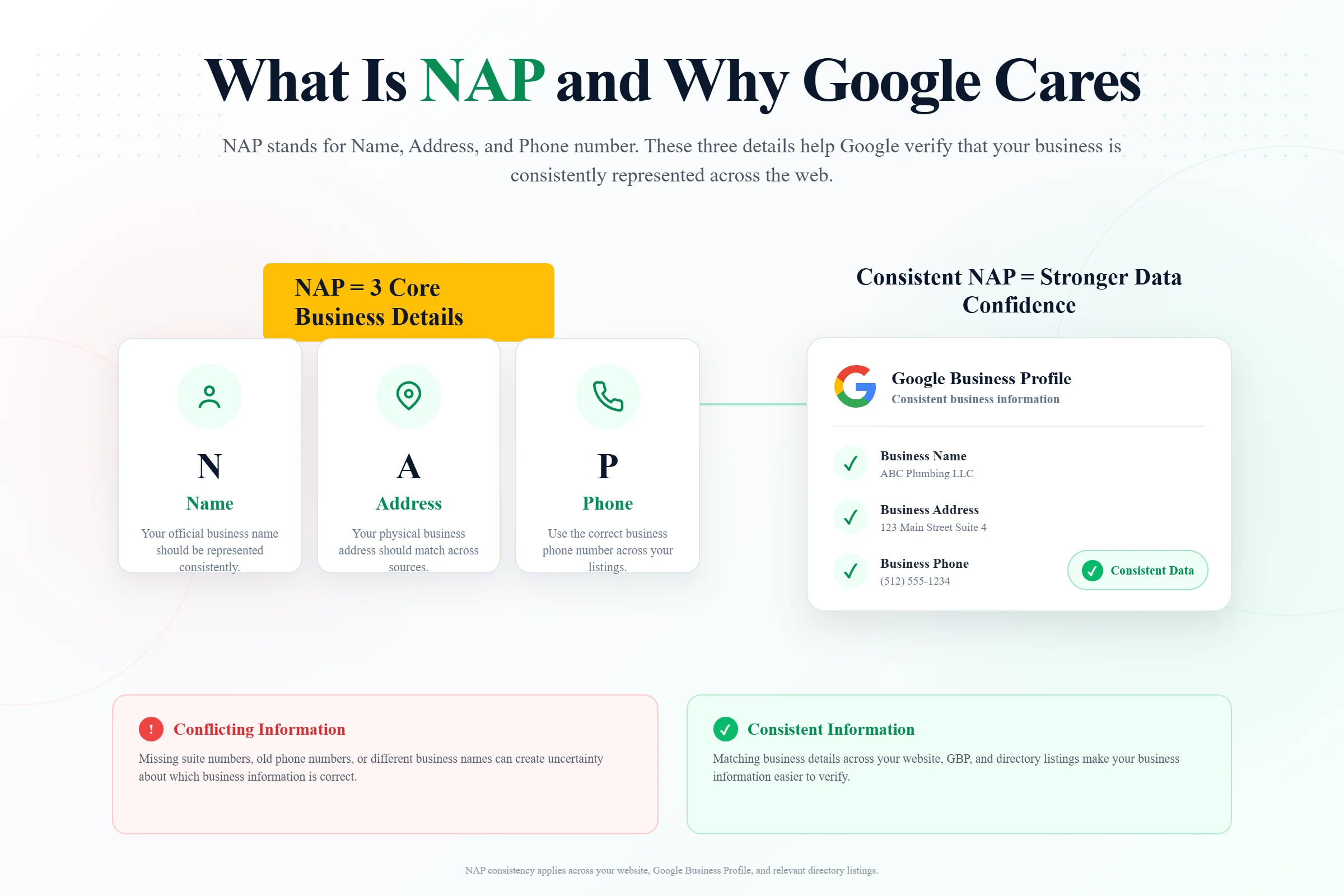
Google treats NAP consistency as a trust signal. When your business name, address, and phone number appear the same way across your GBP profile, your website, your Yelp listing, your Apple Maps entry, and dozens of other directories, Google reads that consistency as confirmation that the data is accurate and the business is legitimate. Consistent NAP data strengthens the local ranking signals that determine where you appear in the map pack.
When those three data points conflict across different sources, Google cannot confirm which version is correct. That uncertainty reduces the confidence Google has in your local ranking signals. A business with 50 directory listings, half of which have a slightly different address format or an old phone number, is sending weaker trust signals than a competitor with 15 clean, consistent listings.
The inconsistency does not have to be dramatic to cause damage. A suite number missing on one listing, an old area code on another.
How NAP Inconsistency Hurts Local Rankings
The most damaging inconsistency I see in audits is not a wrong phone number or a missing suite. It is a business that has moved locations and never updated its old address across its directory listings.
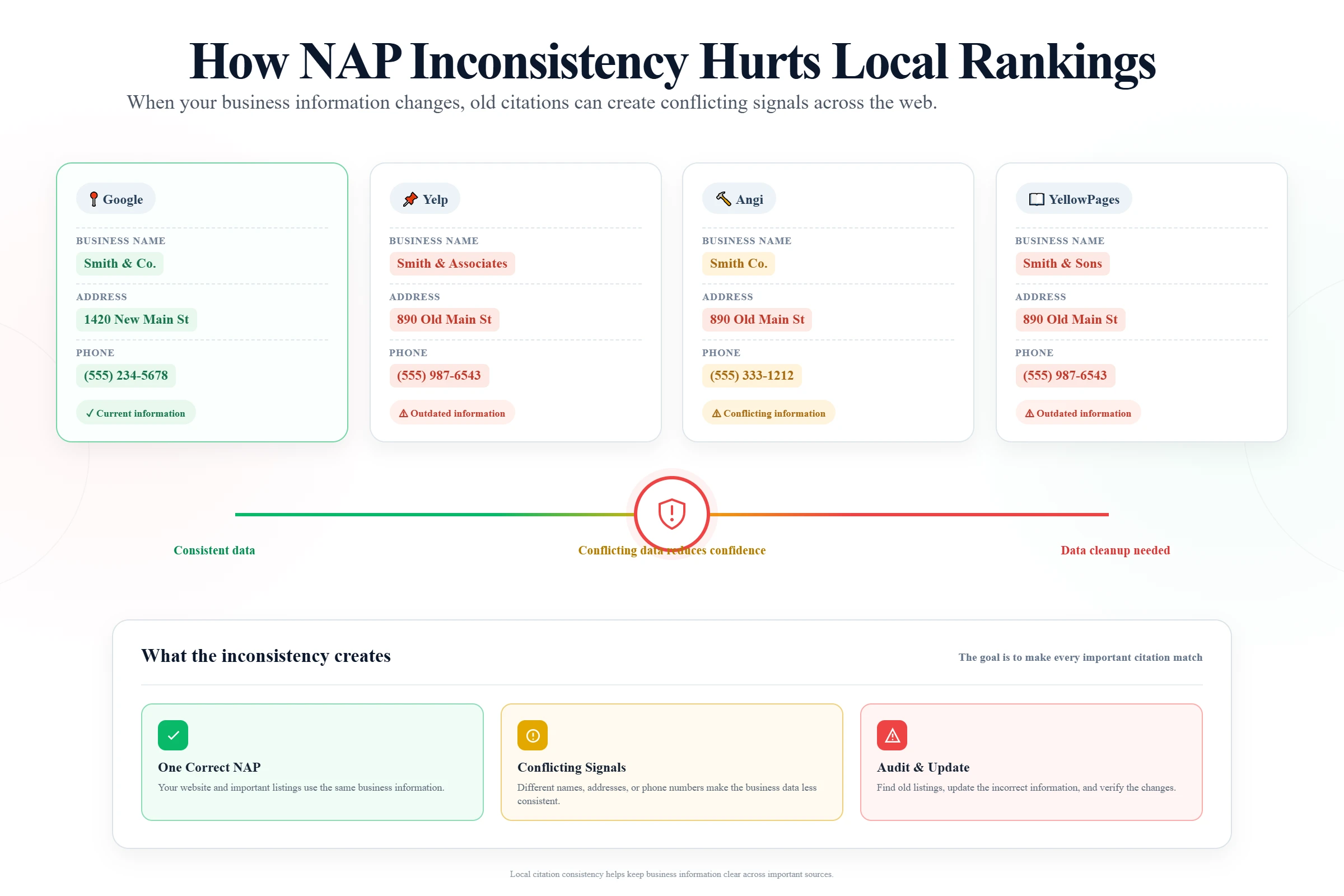
The pattern: a business moves, updates Google and its website, and assumes the rest will follow. It does not. The old address stays live on Yelp, Angi, YellowPages, and a dozen other directories for months or years. Google is now seeing two different addresses for the same business across its data sources. The trust signal collapses. Rankings in the new location take months longer to stabilise than they should because Google is still reconciling the conflicting data.
The fix for an address change is methodical: audit every listing, update each one manually, and verify the update has been published before moving on. It is slow work, but it is the work that restores the trust signal.
Beyond address changes, the other common damage patterns are:
Old phone numbers. A business changes its number and updates Google but not the 30 other directories. Google keeps seeing the old number on high-authority sites and loses confidence in the current one.
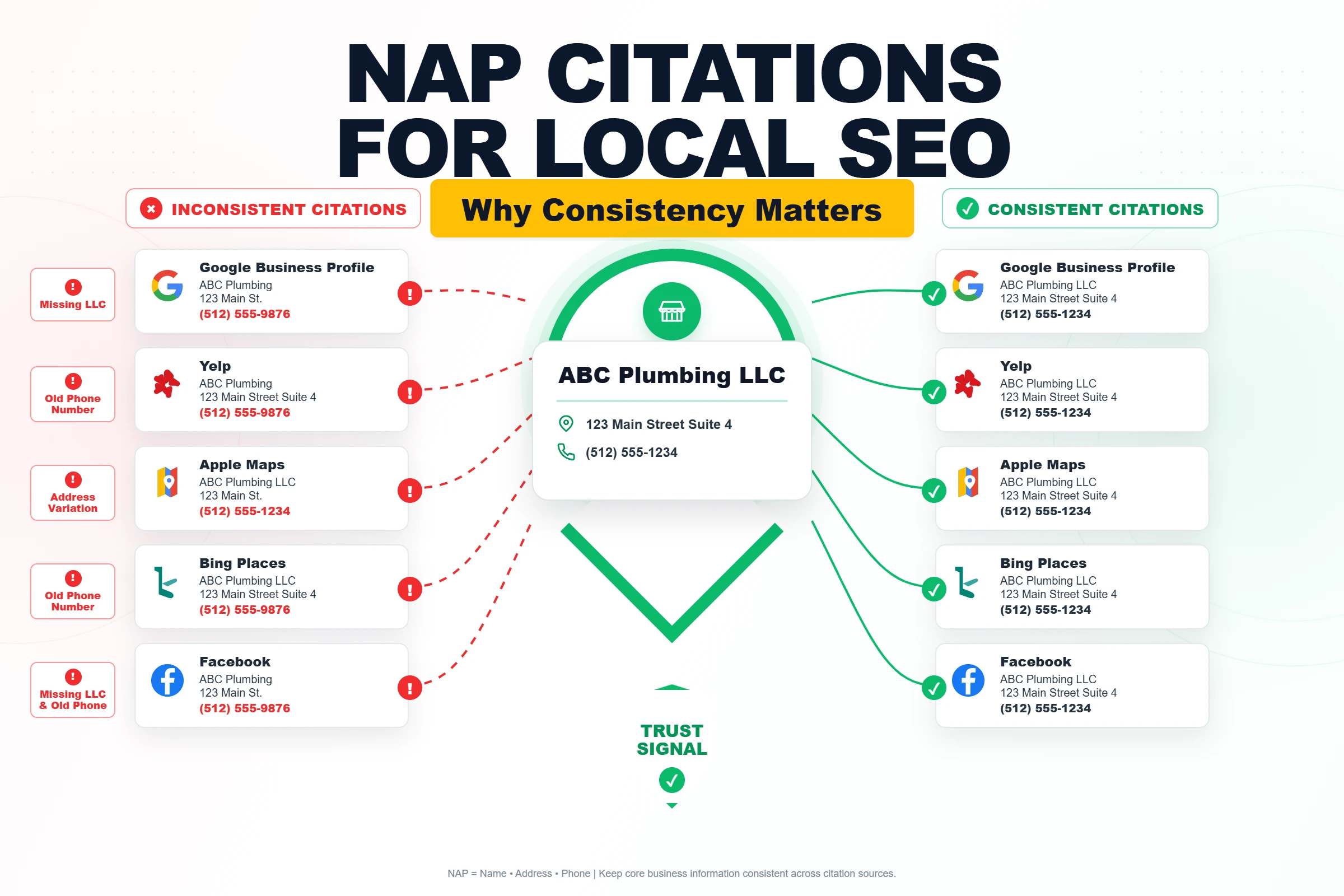
NAP Consistency — Real Example
Google sees these as two different businesses. The name suffix, address abbreviation, and phone format all vary — each one is a small inconsistency, but together they weaken the trust signal Google uses to rank you in the local pack.
Inconsistent suite or unit numbers. “123 Main St” on some listings and “123 Main St, Suite 4” on others. Google treats these as potentially different addresses.
The rule: pick an exact format for your business name, address, and phone number and use it identically everywhere. Not approximately the same. Exactly the same, including punctuation, abbreviations, and number formats.
“In a citation audit for an HVAC client in CA, we found 11 inconsistent listings across the core platforms — including an old suite number on Yelp and Apple Maps from a location move two years prior. After cleanup, the business moved from position 7 to position 4 in the local pack over 9 weeks.”
Core Citations: The Baseline Every Business Needs
Before looking at niche-specific directories, every local business should have these core citations clean and consistent. These are the platforms Google trusts most and the ones it uses most actively when evaluating local business data.
| Site Name | URL | Importance | Why It Matters |
|---|---|---|---|
| Google Business Profile | business.google.com | Critical | Primary local ranking signal. Everything else supports this. |
| Apple Business Connect | businessconnect.apple.com | Critical | Default map for all iPhone users. Large traffic source. |
| Bing Places | bingplaces.com | Critical | Feeds Microsoft search, Cortana, and ChatGPT local results. |
| Yelp | biz.yelp.com | Critical | High-authority citation and active review platform. Scraped by AI tools. |
| Facebook Business | facebook.com/business | Critical | Social proof and citation combined. Scraped by Ask Maps. |
| Better Business Bureau | bbb.org | High | Strong trust signal, especially for higher-ticket services. |
| YellowPages | yellowpages.com | High | Legacy directory with continued indexing value and local trust. |
| Foursquare | foursquare.com | High | Powers location data for many apps and platforms downstream. |
| MapQuest | mapquest.com | Medium | Consistent mention across map-based platforms reinforces NAP. |
| Chamber of Commerce | local chapter URL | Medium | Local authority signal. Especially valuable in smaller markets. |
These are the citations worth fixing first. A business with all ten clean and consistent has a stronger foundation than one with 80 random listings in various states of accuracy.
Industry-Specific Citations by Niche
After the core citations are clean, add the niche-specific directories that serve your industry. These directories carry both citation value and direct lead generation traffic from buyers already looking for your service.
HVAC and Plumbing
Home service businesses benefit most from contractor and home improvement directories. These platforms attract high-intent buyers comparing service providers before calling.
| Site Name | URL | Importance | Why It Matters |
|---|---|---|---|
| Angi | angi.com | Critical | High-intent home service buyers. Strong domain authority citation. |
| HomeAdvisor | homeadvisor.com | Critical | Same audience as Angi. Direct leads plus citation value. |
| Thumbtack | thumbtack.com | High | Active home service marketplace with strong local search presence. |
| Houzz | houzz.com | High | Strong for remodel-adjacent services. High domain authority. |
| Nextdoor | nextdoor.com | High | Neighbourhood-level trust signal. Peer recommendations carry weight. |
| Porch | porch.com | Medium | Home services directory with citation and lead value. |
| Superpages | superpages.com | Medium | Legacy directory still indexed by Google. Useful for NAP consistency. |
For HVAC and plumbing companies, Angi and HomeAdvisor are the priority after the core ten are clean. They are where your buyers are already looking.
Healthcare Providers (Doctors and Dentists)
Patients research a provider before they ever pick up the phone, whether they’re looking for a dentist or a doctor. Most of the platforms that matter here serve both. The split only really shows up at the professional-association level.
| Site Name | URL | Importance | Why It Matters |
|---|---|---|---|
| Healthgrades | healthgrades.com | Critical | Primary patient research platform for doctors and dentists both. High domain authority. |
| Zocdoc | zocdoc.com | Critical | Active booking platform. Patients book directly through the listing, physician or dentist. |
| WebMD | webmd.com/find-a-doctor | Critical | High trust authority. Patients research here before calling, mainly for physicians. |
| Vitals | vitals.com | High | Patient review platform with strong indexing, covers both professions. |
| RateMDs | ratemds.com | High | Active patient review source. Skews toward physicians but indexes dentists too. |
| CareDash | caredash.com | Medium | Growing healthcare directory with strong Google indexing. |
| ADA Member Directory | ada.org | High | Dentist-specific. The professional-association trust signal for dental practices. |
| Practo | practo.com | Medium | Relevant mainly if you serve international patient populations — most US/UK/Canada practices can skip this one. |
| NPI Registry | npiregistry.cms.hhs.gov | Medium | Official U.S. federal provider registry — covers doctors and dentists both. Not a review platform, but an authoritative NAP source that insurers and other directories pull from. |
For a dental practice, the ADA directory is the one non-negotiable addition on top of the general list. For a physician’s office, there isn’t a clean equivalent – the NPI registry is the closest official source, but it’s a lookup, not a review platform, so don’t expect it to drive traffic the way Healthgrades or Zocdoc will.
Restaurants and Cafes
Restaurants need both citation consistency and discovery platform presence. Customers find restaurants through maps, review platforms, and booking apps, often within minutes of deciding to eat.
| Site Name | URL | Importance | Why It Matters |
|---|---|---|---|
| TripAdvisor | tripadvisor.com | Critical | High-intent discovery platform. Tourists and local diners both use it. |
| OpenTable | opentable.com | Critical | Active reservation platform. Booking intent is highest here. |
| Zomato | zomato.com | High | Strong in urban markets and regions with active food discovery. |
| Foursquare | foursquare.com | High | Powers food discovery in multiple downstream apps. |
| Uber Eats Merchant | merchants.ubereats.com | High | Delivery audience and citation value combined. |
| DoorDash Merchant | merchant.doordash.com | High | Same as Uber Eats. Delivery platform presence reinforces local identity. |
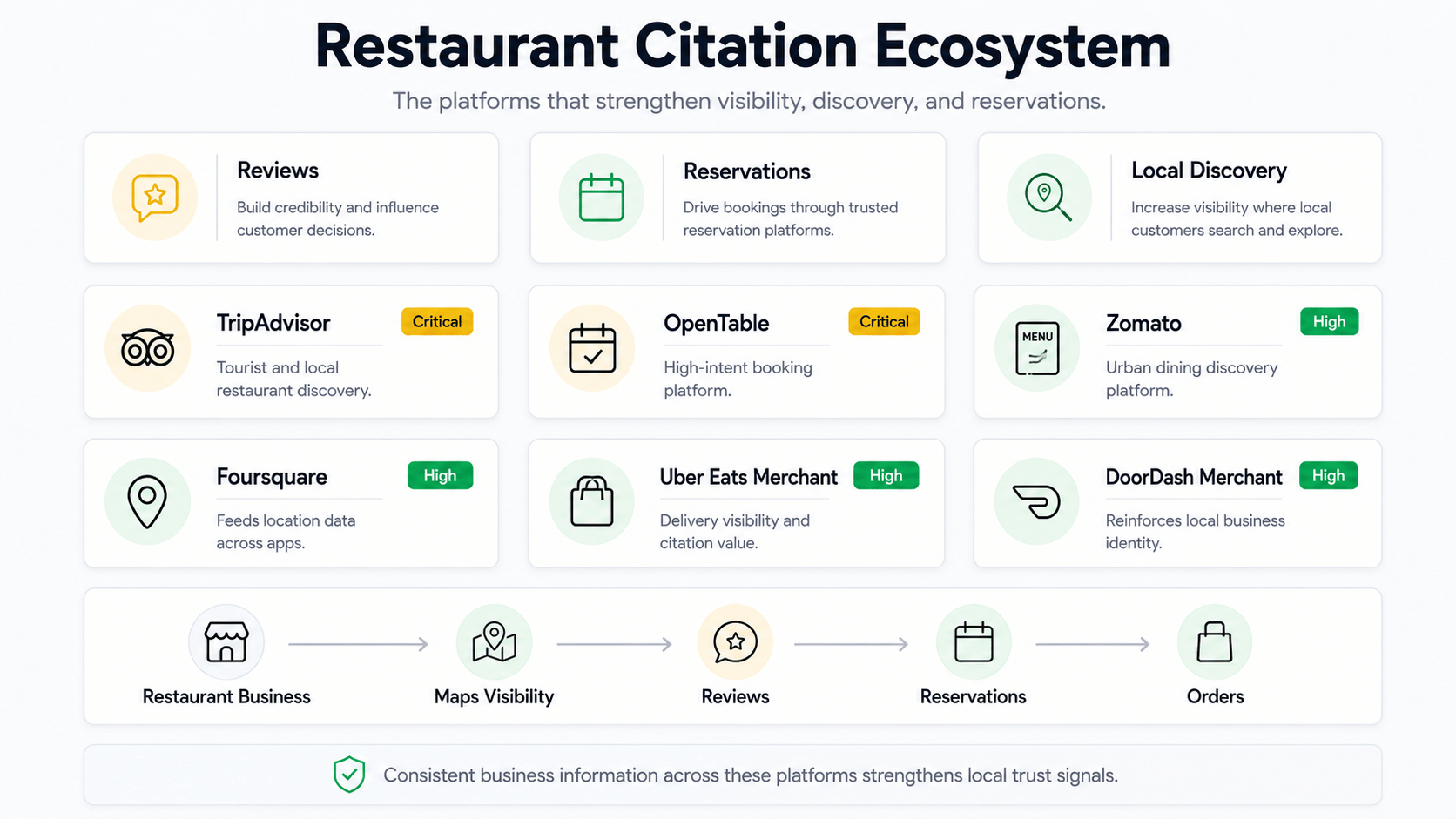
For restaurants, TripAdvisor and OpenTable are the priority after the core ten. The delivery platform merchant listings also function as citations that reinforce NAP and add local search visibility.
Roofers
Roofing has a research step most home-service categories don’t: homeowners check manufacturer certifications before hiring, because the certification affects the warranty on the roof itself, not just the workmanship.
| Site Name | URL | Importance | Why It Matters |
|---|---|---|---|
| GAF Certified Contractor Network | gaf.com | Critical | Manufacturer certification directory. Homeowners specifically search for GAF-certified installers because it protects the shingle warranty. |
| CertainTeed Certified Contractor Program | certainteed.com | High | Second major manufacturer certification directory. Same warranty-driven search behavior as GAF. |
| Owens Corning Roofing Contractor Network | owenscorning.com | High | Third major shingle manufacturer’s contractor locator, same logic. |
| NRCA Member Directory | nrca.net | Medium | National Roofing Contractors Association. Trade-association trust signal. |
| BuildZoom | buildzoom.com | Medium | Contractor licensing/verification platform. Covers roofers directly. |
How to Audit Your Own Citations Using a Citation Audit Template
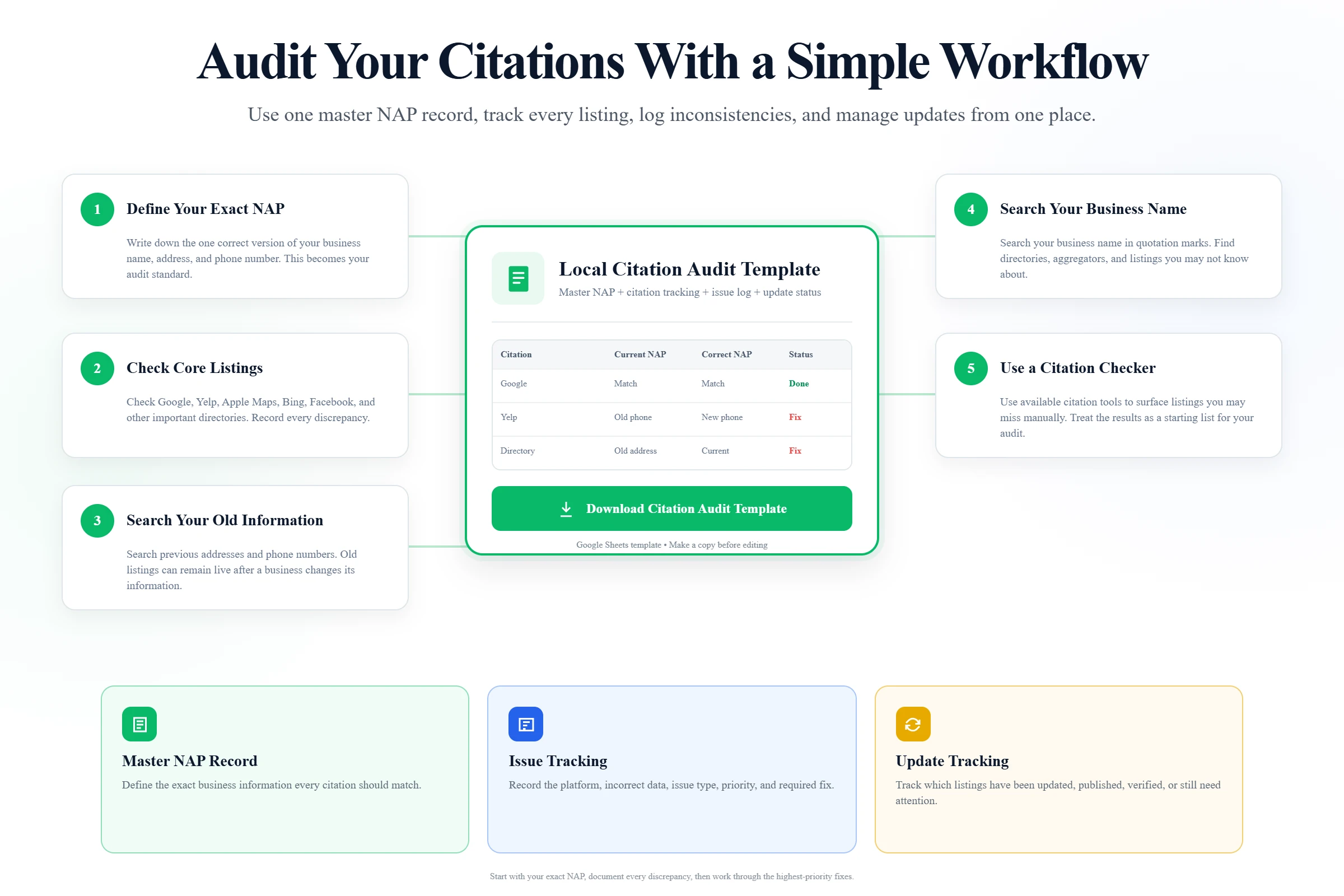
You do not need a paid tool to audit your citations. Download the Local Citation Audit Template below and follow the process step by step. The template includes a master NAP record, citation tracking sheet, issue logging, and update tracking workflow.
Download the Local Citation Audit Template: Use the spreadsheet to track every listing, document inconsistencies, and monitor updates as you work through the audit process.
Download the Local Citation Audit Template
Track every citation, identify inconsistent business information, prioritize fixes, and manage updates from one place.
Important: This is a Google Sheets template. Open the sheet and create your own copy before making changes.
To use the template: Click File → Make a Copy in Google Sheets, then save it to your own Google Drive.
Step 1: Define your exact NAP format. Before auditing anything, write down the single correct version of your business name, address, and phone number. Decide: do you use “St” or “Street”? Do you include the suite number? Is the phone number formatted with dashes or dots? This becomes the standard every listing gets measured against.
Step 2: Check your core listings manually. Search for your business name on Google, Yelp, Apple Maps, Bing, and Facebook. Check each listing against your exact NAP format. Note every discrepancy in your Citation Audit Tracker. Record the platform, current listing details, correct NAP information, issue type, priority level, and update status. This creates a complete record of every citation that needs attention.
Step 3: Search for your old information. If you have ever changed your address or phone number, search for the old data specifically. Type your old address or old phone number into Google and see which directories are still showing it. These are the highest-priority fixes because they are actively sending conflicting signals.
Step 4: Search your business name in quotes. Search “Your Business Name” in Google to find listings you may not know exist. Data aggregators, local directories, and scraped listing sites sometimes create entries without your involvement. Each inconsistent entry is a signal leak.
Step 5: Use a free citation checker. Tools like BrightLocal’s Citation Tracker (limited free version), Whitespark, or Semrush’s listing management tool can surface listings you would miss manually. Even a one-time free scan gives you a useful starting list.
How to Fix Inconsistent Citations
Once you have the audit list, fix citations in priority order: core platforms first, then niche-specific directories, then secondary mentions.
For each listing:
- Log in to the platform directly if you have an account. Claimed listings are the easiest to fix.
- Update the name, address, and phone number to match your exact NAP format.
- Submit the change and note the date in your spreadsheet.
- Return in 2 to 4 weeks to verify the update has published. Some platforms have slow review cycles.
For listings you do not own:
- Claim the listing through the platform’s ownership process.
- Some platforms require verification by phone or postcard.
- For platforms that do not allow claiming (some legacy directories), submit a correction request through their update form or contact support.
For duplicate listings:
- If two listings exist for your business on the same platform, claim both and request that the duplicate be removed or merged.
- Do not leave duplicates live. Google sees two entries for the same business and reduces confidence in both.
Citation cleanup vs citation building:
Fix first, build second. Adding new consistent citations before cleaning up existing inconsistent ones compounds the problem. Google is already receiving conflicting signals. Adding more clean listings does not cancel out the noisy ones. Clean the foundation, then build on top of it.
How Long Citation Fixes Take to Impact Rankings
Citation changes do not produce overnight results. Here is the realistic timeline so you know what to expect.
Directory update: 1 to 4 weeks for most platforms to publish a submitted change. Some legacy directories take longer.
Google re-indexing: 2 to 6 weeks after the directory updates for Google to re-crawl the page and register the corrected data.
Ranking impact: 4 to 12 weeks from the fix date before citation improvements typically show up in local ranking movement.
The full cycle from submitting a correction to seeing a ranking change is usually 6 to 12 weeks. This is why citation work often feels slow. The fix is real, but the impact is delayed by indexing and algorithmic processing cycles.
Set accurate expectations before starting. Citation work is a foundation play, not an overnight ranking strategy. The businesses that benefit most from it are the ones that did the audit early, fixed everything systematically, and then maintained consistency as the baseline for every other local SEO effort.
Diagnostic Checklist: Citation Audit
| Check This | Action If No |
|---|---|
| Have you defined your exact NAP format in writing? | Write it down now and use it as the standard for every listing |
| Is your GBP name, address, and phone number in that exact format? | Update GBP first. It is the highest-priority listing. |
| Have you checked Apple Maps, Bing, Yelp, and Facebook manually? | Work through the core four before anything else |
| Have you searched for your old address or phone number in Google? | Search for old data and audit every listing that appears |
| Do you have duplicate listings on any platform? | Claim and remove duplicates before building new citations |
| Have you built niche-specific citations after the core ten are clean? | Angi, HomeAdvisor, Healthgrades, TripAdvisor, or the manufacturer/trade-association directories (GAF, NRCA) based on your industry |
FAQ
What does NAP stand for in local SEO? NAP stands for Name, Address, and Phone number. These are the three core data points Google uses to verify your business identity across the web. Consistent NAP data across your GBP, website, and directories strengthens your local ranking signals. Inconsistent NAP weakens them.
How many citations does a local business need? There is no magic number. A business with 15 clean, consistent citations on high-authority platforms will outrank one with 100 inconsistent listings on random directories. Quality and consistency matter more than volume. Start with the core 10 platforms, then add niche-specific directories relevant to your industry.
Does NAP consistency still matter in 2026? Yes. Google still uses citation data as part of its local ranking evaluation, and AI tools like Ask Maps pull from directory listings when generating answers about businesses. Inconsistent NAP creates conflicting signals that reduce confidence in your business data across both traditional search and AI-driven discovery.
What is the fastest way to fix NAP inconsistencies? Start with your four highest-authority listings: Google Business Profile, Apple Maps, Bing Places, and Yelp. Fix those first, then work through the rest of your core citations. Use a spreadsheet to track every listing, the current data, the correct data, and when you submitted the update.
Should I use a citation management service or do it manually? Manual auditing gives you the most control and the clearest picture of what is actually live. Services like BrightLocal and Whitespark can automate parts of the process for a monthly fee. For most small businesses doing a one-time cleanup, the manual process is sufficient. For ongoing citation management across many locations, a tool is worth the investment.
Will fixing citations guarantee a ranking improvement? No. Citation consistency is one of many local ranking factors. Fixing inconsistencies removes a trust signal leak that may be suppressing your rankings. The improvement depends on how significant the inconsistency was and how competitive your local market is. Expect 4 to 12 weeks before any impact is visible in rankings.